Portable workouts for an Algarve winter
Training routines that need a backpack's worth of kit: bands, one kettlebell and your own body weight, for the beach at low tide, a rental with tiled floors and a coliving group. Written for a winter stay from January to March.
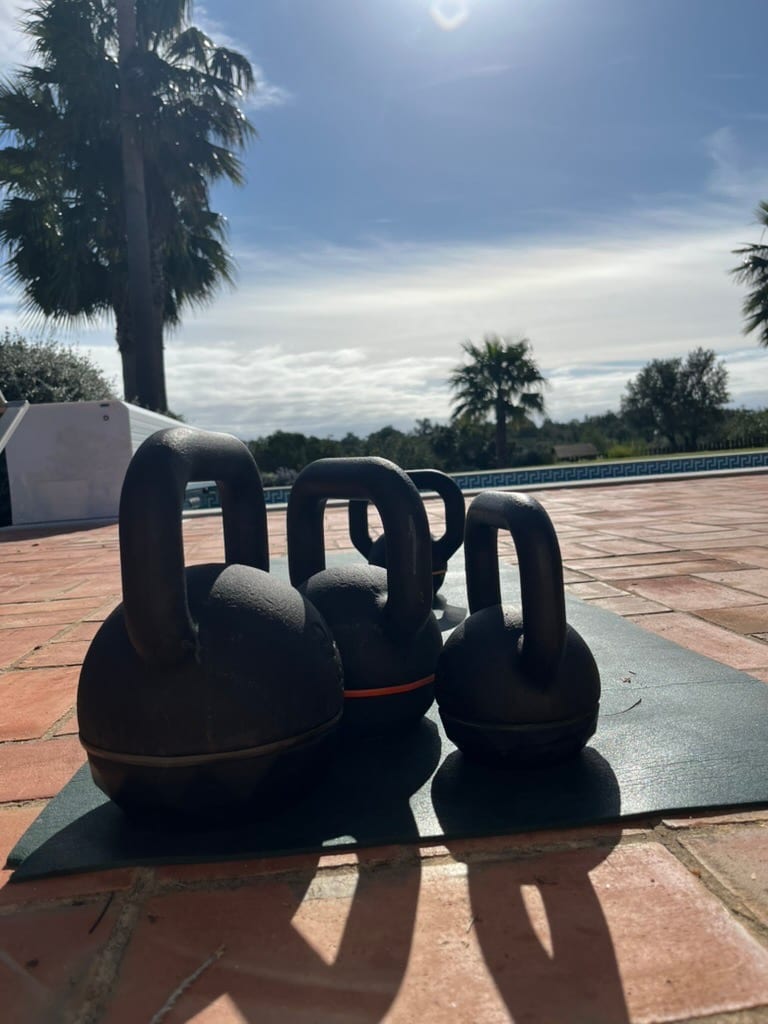
A small set of gear and a few fixed routines are enough to train well through a winter stay in the Algarve. This guide gives you a packing list, three sessions that use it, a low-tide routine for the beach, a quiet routine for a rental flat and four group formats for a coliving house. Everything here works with resistance bands, one kettlebell and your own body weight.
The guide is about routines and formats. It does not cover where to surf or swim in winter; that is in the outdoor training guide. It is written for a full-time remote worker, so every session fits into 20 to 45 minutes.
One rule runs through all of it: choose a few sessions you can repeat, and repeat them. Variety is nice. A routine you actually do on a wet Tuesday in February is better.
The portable kit
If you travel with a carry-on only, that decides the kit.
| Item | In the bag? | What it covers |
|---|---|---|
| Long loop resistance band (two strengths) | Yes | Rows, presses, pull-aparts, assisted pull-ups, leg work |
| Short mini band | Yes | Hip and glute work, warm-ups |
| Travel mat or towel | Yes | Floor work, protection for tiles and wood |
| Kettlebell | No, use the one where you stay | Swings, goblet squats, carries, presses |
| Suspension trainer | Optional | Rows, push-ups, lunges from a door or a beam |
Ask the house what it has before you pack. At Pomar na Praia in Fuseta, the open-air gym has TRX straps, kettlebells up to 25 kg and mats. One guest in the 2026 season trained with the kettlebell, mats and bands in the garden from the second week.
Three sessions with one kit
Each session starts with five minutes of easy movement: marching, arm circles, hip circles, a few slow squats. Choose a load that leaves two or three clean repetitions in reserve at the end of each set.
Session 1: bands and body weight (about 30 minutes)
Three rounds. Rest 60 to 90 seconds between rounds.
- Band row, 12 repetitions
- Push-up (hands on a bench if needed), 8 to 12 repetitions
- Split squat, 10 per leg
- Band pull-apart, 15 repetitions
- Side plank, 20 to 30 seconds per side
Session 2: one kettlebell (about 30 minutes)
Four rounds. Rest as needed.
- Goblet squat, 10 repetitions
- Kettlebell swing, 15 repetitions
- One-arm row, 10 per arm
- Suitcase carry, 30 metres per hand
If you are new to the swing, learn it from a coach or the house’s community workout before you load it.
Session 3: mobility block (about 20 minutes)
Slow and controlled. Two rounds, 60 seconds per position.
- Deep squat hold, with support
- Half-kneeling hip stretch, each side
- Thoracic rotation on all fours, each side
- Calf and ankle rocks against a wall
- Dead hang from a bar or a TRX-supported squat hold
Barefoot routines at low tide
Low tide opens a wide band of firm, wet sand. That is a better surface for barefoot work than the soft sand higher up.
Where to find tide times
- Instituto Hidrográfico, the Portuguese navy’s hydrographic office, publishes the official tide tables every year; use the edition for the year of your stay. Volume I covers Portuguese ports, with a section for Faro-Olhão1.
- Windfinder shows high and low water times and heights for Faro-Olhão, up to 10 days ahead2. Its predictions are not meant for navigation2.
- Use Faro-Olhão as the reference for Fuseta and plan a margin of time around it.
The town beach, Fuseta-Ria, is on the lagoon side and can be reached on foot from the village3. At high tide the water surrounds the lifeguard station3. Do not try to wade across a channel. Water levels and currents can change quickly3.
A 30-minute low-tide routine
Start on the firm sand about an hour before low tide, so the beach is still getting wider while you train.
- Walk barefoot for five minutes on the firm sand, then two minutes on the soft sand.
- Foot work: 3 rounds of 15 slow calf raises, 10 toe spreads and 30 seconds standing on one leg per side.
- Sand strides: 6 runs of about 30 metres at a controlled, fast pace on the firm sand. Walk back each time.
- Core along the waterline: 3 rounds of a 30-second plank, 10 slow dead bugs and 10 bird dogs per side.
- Walk back at an easy pace.
Look at the sand before you run on it. Shells, stones and fishing gear wash up. If your feet are not used to bare sand, keep the strides short for the first weeks.
Quiet workouts for a rental flat
Tiles and wooden floors carry impact noise to the flat below and can crack under a dropped weight. A quiet session protects the floor and keeps the neighbours on your side.
Portuguese law treats 23:00 to 07:00 as the night period. Inside those hours, police can order neighbour noise to stop at once4. Train between 07:00 and 23:00, and keep it quiet even then.
How to keep a session quiet:
- No jumping. Replace jumps with slow squats, step-backs and tempo work (three seconds down, one second up).
- Mat or folded towel under every floor movement, and under a kettlebell when you set it down.
- Bands instead of weights for upper-body work. Nothing to drop.
- Isometric holds: wall sit, plank, glute bridge hold, 30 to 45 seconds each.
- On a balcony, check the railing height and keep the band anchor away from it. Do not anchor a band to a balcony railing.
A 25-minute quiet circuit, three rounds:
- Tempo squat, 10 repetitions
- Band press, 12 repetitions
- Reverse lunge, slow, 8 per leg
- Band row, 12 repetitions
- Wall sit, 40 seconds
Group formats without equipment
A coliving house has what a solo traveller lacks: other people at the same time each week. At Pomar na Praia in the 2026 season, the community manager ran a weekly community workout. From week seven a guest helped run it, and the group did its first beach session that same week.
These four formats work for mixed groups of 4 to 12 people:
| Format | How it works | Time |
|---|---|---|
| Station circuit | One exercise per station, 40 seconds work and 20 seconds to move | 20–30 min |
| Partner resistance | One person moves, the other gives steady, light resistance with a towel or a band | 15–20 min |
| Sprint relay | Teams of 2 or 3 take turns on a 20-metre lane on grass or firm sand | 10–15 min |
| Ladder | Add one repetition each minute (1 squat, 2, 3…) until someone chooses to stop | 10–12 min |
How to run a session:
- One person keeps the time. Everybody else just works.
- Give two versions of every exercise, an easier one and a harder one. People choose.
- Warm up together for five minutes before anything fast.
- Keep partner resistance light and slow. No pulling or pushing that a partner cannot stop at once.
- Fix the day and the time. A session that happens every week builds the group more than a hard one that happens once.
Checklist
- Two loop bands, one mini band, a light mat or towel in the bag
- Ask the house about kettlebells, straps and mats before you arrive
- Three repeatable sessions written down
- Faro-Olhão tide times checked the evening before a beach session
- Firm sand only for strides; no wading across channels
- No jumping and no dropped weights on tiles or wood
- Indoor sessions only between 07:00 and 23:00
- One group session a week with a fixed day and time